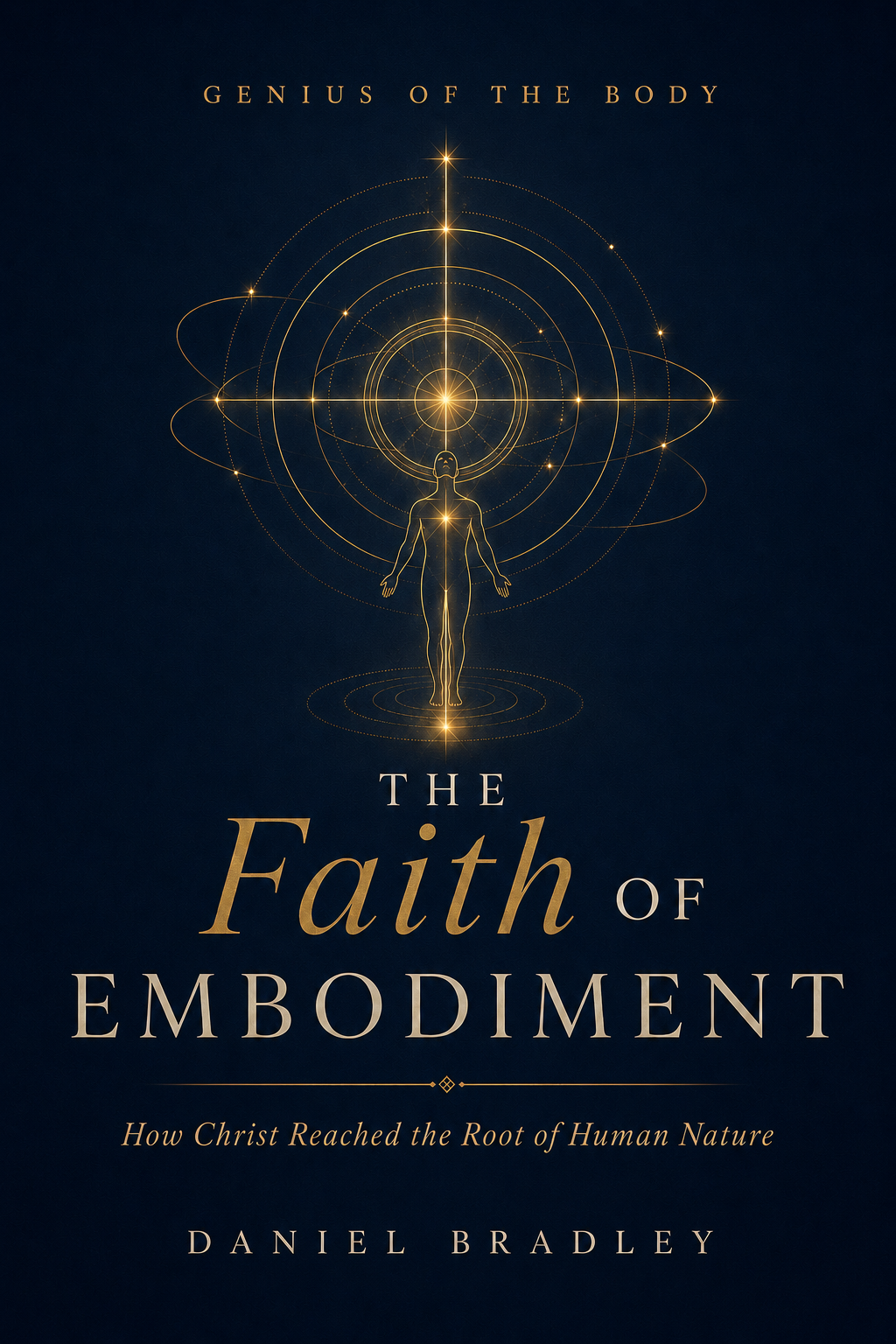
A Concentrated Work of Christian Spiritual Formation
Every serious spiritual path in the world moves upward — a human being reaching, refining, ascending toward a divine assumed to be elsewhere. Christianity moves the other way. It begins with God descending, all the way in, without remainder, into the exact material we were trying to transcend.
At no cost. No purchase required.
If this were a faith about escaping the body, the people who understood it best would be the least troubled by theirs.
You can affirm the resurrection and still brace when someone reaches for you. You can know you are forgiven and still carry the posture of a man waiting to be found out.
You were handed a religion of ideas. You were given a faith of bodies.
Perhaps You Have Lived This
This work is written for the person who already understands, and is still not free.
None of that is a failure of sincerity. It is a nervous system with a history — and an intelligent reason for every adaptation it made.
Receive the Work
How Christ Reached the Root of Human Nature
A concentrated work, written to be read in a single attentive sitting and returned to. Enter your first name and email and the document will be sent to you.
At no cost. No purchase required.
I · The Fall Guy
The body-blaming Christianity many of us inherited did something Paul never did. It confused the body with the flesh, and then made embodiment itself answer for humanity's estrangement from God.
The body as an organized whole. In Paul it is never intrinsically negative. A living sacrifice. A temple. Redeemed. Raised. He never once anticipates escaping it — not at conversion, not at death, not at resurrection.
An orientation, not a substance. Humanity organized apart from God, curved toward itself. Paul proves it himself: the works of the flesh he lists are hatred, jealousy, wrath, envy, factions. You cannot commit envy with your muscles.
One word named a condition. The other named a body. The tradition collapsed them, and your body has been serving the sentence ever since.
The idea that spirit is pure and matter corrupt, that the body is a prison and salvation is escape from it — the early church named that and defeated it. It came back centuries later through the side door, dressed as piety. It never announced itself. It arrived as a tone.
II · The Root
The New Testament word is ἁμαρτία — a term out of archery. To miss the mark. And Paul is astonishingly consistent with it: sin entered, sin reigned, sin dwells, sin deceived. You do not talk that way about a list. You talk that way about a power with a grip on something living. When he wants to name the deeds, he has other words and he uses them.
And he tells you what the mark actually was. All have sinned and fall short of the glory — a glory, not a rulebook. The mark was a form. The shape a human being was made to carry.
Your body is not you. But it is the most honest record of you in existence. It was recording before you had language — learning whether love was safe, whether anger threatened attachment, whether need was welcomed or punished. When the answers came back wrong, it did the intelligent thing. It adapted. The throat learned not to cry. The jaw learned that anger was dangerous. The breath pulled up out of the belly and never came back down.
You cannot repent your way out of a shape. Moral effort applied to a distorted form produces a more disciplined distorted form — which is the entire history of religious striving in one sentence.
Which is exactly why God did not send a better list.
III · The Mechanism
His word for what happened to the mind is πώρωσις — from a Greek medical term for the bony callus that forms over a fracture. Scar tissue formed over a break. Then Ephesians gives the full sequence, in his order: alienated from the life of God, because of the callus of the heart; who being past feeling — ἀπηλγηκότες, away from pain, analgesia — have given themselves over.
That is not a metaphor for armouring. That is armouring, described in the first century. And it reverses the entire method you were raised under. If numbness comes before the behaviour, then moral pressure applied to the behaviour cannot restore sensation. It can only give the organism one more reason to harden.
A body that learned to disappear under judgment will not come alive under more judgment.
The full argument, and the order it follows, is set out in the document.
Receive The Faith of EmbodimentIV · The Evidence
Paul inherited a language perfectly capable of describing religion, ethics, law, sacrifice and mystical experience. It could not describe what had happened to him. So he broke it.
So far as our surviving Greek shows, nobody had ever said it. He did not coin a word for shared belief, shared covenant, or shared conviction. When Paul reached for a word to name what we now are, he built it out of body.
My chest has opened and has stayed open; yours is compressed into a narrow space. His prescription is not believe harder. It is a thoracic instruction, from the apostle, in Scripture, sitting there for two thousand years.
Paul's word for the seat of affection is not the sanitized heart of a greeting card. It is the viscera. I long after you all in the splanchna of Christ Jesus.
He wrote all of it from a body under load — in weakness and much trembling, pressed out of measure, our flesh had no rest. The most exalted theology in the New Testament came out of a man describing, in the same breath, a body that hurt.
V · The Order
If sin is a distortion of form, salvation cannot be a stricter rule. It has to be a re-formation — and Paul says exactly that, in form-vocabulary. Until Christ be formed in you: morphogenesis, the word for a shape emerging in a living thing. Co-formed with the Son. Be transfigured by the renewing of your mind — and both of those verbs are passive. He does not say transform yourself.
The sequence of growth follows: θλῖψις, pressure. ὑπομονή, remaining under — not gritting your teeth until it passes, but staying present with something instead of leaving. δοκιμή, the assayer's word, metal put through fire and proved genuine. And then hope, which does not put you to shame, because the love of God has already been poured out and stands poured.
More ground makes more charge bearable. More charge reveals more of the defence. More love makes more of the feeling tolerable. More completed feeling returns more energy to the body — which enlarges the person, and makes the next layer reachable for the first time. The material returns not because nothing happened. It returns because something did. What was too much for you at one level of aliveness is exactly right at the next.
You are not becoming somebody else. You are being un-bent.
Inside the Document
The Faith of Embodiment is a concentrated work of Christian spiritual formation — written to be read attentively in a single sitting and returned to. It is not a programme, a technique, or a system to apply. It is an account of what was always true of the faith you were given, and of the body that has been waiting for it to arrive.
A Note on What Is New Here
This is not new. It is recovery. While the West drifted toward salvation as mental assent, the East kept the whole thing in the tissue — standing prayer, prostrations, fasting as bodily discipline, incense, chant, the sign of the cross traced on the body thousands of times over a life, attention descended out of the head into the heart and paced with the breath. What is genuinely new is not the theology. It is the vocabulary. The fathers had the practices, the doctrine and the results, but no map of the mechanism. That map now exists. Putting it beside them is not innovation. It is annotation.
The union is finished. It was settled in the perfect tense and the passive voice — done to you, complete, standing.
Your body has not caught up yet.
That is not a failure of faith.
Forgiveness has to reach the place that still expects punishment. Adoption has to reach the place that still braces for abandonment. Love has to reach the feeling that went quiet to preserve the attachment.
Your body was right. It was pointing home the entire time.
Receive the Document
How Christ Reached the Root of Human Nature
Enter your first name and email, and the document will be sent to you. Read it when you have an unhurried hour. Return to it when the same material comes back around.
At no cost. No purchase required.
About the Author
Daniel Bradley is the founder of Genius of the Body, a Christ-centered embodiment ministry built at the intersection of Scripture, the Church Fathers, the nervous system, and the body as the site of redemption. This work is devoted to one thing: knowing who we are as new creations in Christ — through the same Spirit who raised Him from the dead, now giving life to our mortal bodies.