Genius of the Body The Essay
An Essay · A Free Invitation

There is a kind of hope you reach for.
And a kind of hope you live from.

One is exhausting because it is reaching. It has nowhere to stand. The other does not strain, because it is no longer trying to escape anything.

Hope in the Body

How the Heart's Outward Reach Is Lost —
and How It Comes Home Under Christ

Daniel Bradley

Receive the essay free One essay. Free. No purchase. Read it in a single sitting.
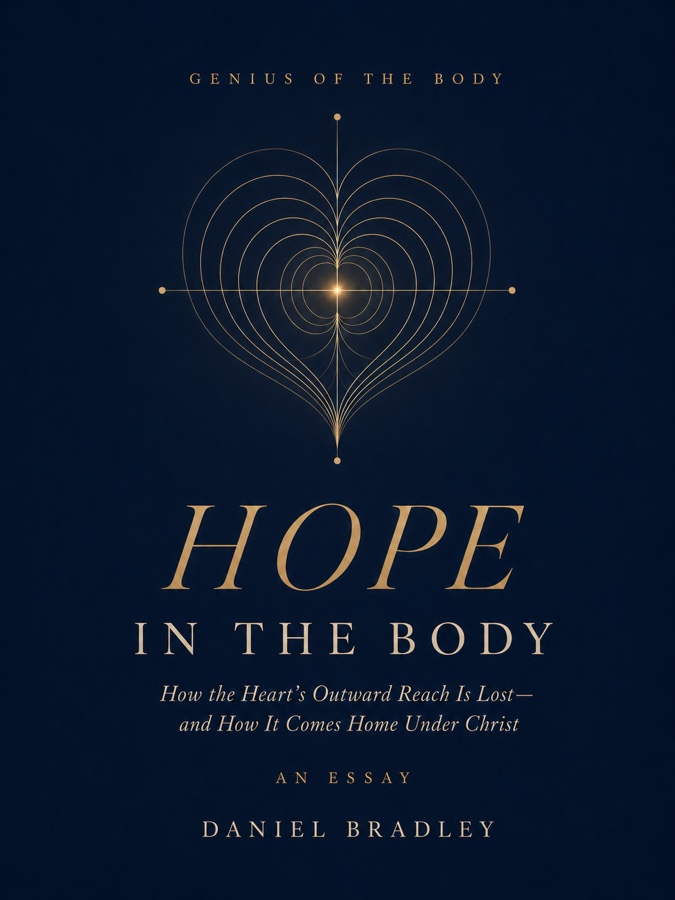
Hope in the Body — essay cover by Daniel Bradley
Perhaps You Have Felt This

You may have carried a chest that has held for years. Shoulders raised against the next disappointment. A breath quietly braced. You may have a loving marriage, a real faith, a good life — and still not be able to feel held.

You may have prayed, and believed, and meant it. And still found that something in you remains at a careful distance from the very grace you confess. Not because you doubt it. But because the body has its own conclusions, drawn long before the mind had words for them.

Because you have been the only ground you know for so long that being held by anything else has become structurally impossible.

This is not a failure of faith. It is the shape of a wound. And it has a name, and a history, and — this is the good news — it has a way home.

How the Reach Was Lost

The body was made to reach. When love is given and received, something in the chest opens and moves forward — an expansion, a leaning toward. That outward reach is hope before the word for it. It is the imago Dei in cardiovascular form: the image of a God who is himself outward-moving, self-giving, radiant.

But when the reach is denied — when the arms that should have received it were absent, or frightened, or too burdened to hold — the circulation does not simply stop. It withdraws. It turns inward. The chest learns to seal. The body, finding no ground outside itself, becomes its own ground. It holds itself up by its own effort, and calls this survival.

The reach forward, denied, becomes pressure trapped in the heart.

Over time, this becomes the only posture the body knows. Not chosen. Not sinful in its origin. Simply the organism doing what organisms do when the field that was meant to receive them does not. And from that sealed interior, a whole theology is quietly constructed — about what God is like, about whether grace is real, about whether the body itself belongs.

Why More Information Has Not Been Enough

You may have read the right books. Heard the right sermons. Understood, intellectually, that you are loved. And still found that something in the chest does not move. This is not stubbornness. It is not unbelief. It is the simple fact that words arrive at the surface of a sealed thing and do not enter.

No amount of doctrinal correctness will release it, because it does not enter the rigid chest. It bounces off.

This essay is not therapy. It is not a technique, a framework, or a motivational reframe. It is the Gospel — the whole Gospel, meant for the whole person. The Gospel that does not merely inform the mind but descends into the body, into the breath, into the sealed chest, and does there what only the living Christ can do.

And Then the Spirit Was Given

The Cross did not happen at a distance from the body's heartbreak. It descended through every layer of it. The abandonment. The sealed chest. The breath held against the next blow. The body that had become its own ground, now given over entirely — and received, in that giving-over, by a Ground that does not fail.

The resurrection was in a body. Not a symbol. Not a spiritual metaphor. A body that breathed, and ate, and was touched, and reached — and from which the Spirit was poured out into the bodies of those who receive him. The indwelling Spirit becomes the receiving Ground the maternal field could not be. Not borrowed from another person. Not manufactured by effort. Living, from within.

The Gospel is not merely information the mind agrees with. It is the living reality of Christ progressively unfolding within the human body. Hope is not added from outside. It is the God-given life of the redeemed organism coming back into circulation under Christ.

Hope is not generated. It is resumed.

The image is becoming the likeness. The latent Christ is becoming the lived Christ. The body has come home, and from home it radiates.

What You Will Find Inside
  • The body's first theology, and why your nervous system decided what God would feel like before you had words.
  • How innocence is converted to guilt, and rightness is traded for a borrowed righteousness that must be endlessly maintained.
  • How the Cross descends through every layer of the body's heartbreak — not past it, not above it, but through it.
  • What restoration actually feels like — the breath, the sob, the legs, the yes, and finally the reach.
  • Safe. Secure. Seen. Soothed — not borrowed from another, but living from the indwelling Spirit as the Ground that no longer fails.
  • The organic revelation of what the Gospel has always meant for the whole person — not a new technique, but an ancient homecoming.

Approximately 5,200 words — a concentrated essay, written to be read in a single meaningful sitting and returned to whenever you need it. Not a book. Not a course. Not a program.

Receive Hope in the Body, Free

Enter your email and the essay will be sent to you — freely, without obligation. Read it when you are ready. Return to it when you need it.

One free essay, delivered to your inbox. No purchase.
You can read it in a single sitting and return to it whenever you need it.

The cross settled the territory. The Spirit indwells the body. The image is at the root, waiting.

You can come home. Receive the essay free

The work is finished. Your body was made to enjoy it.